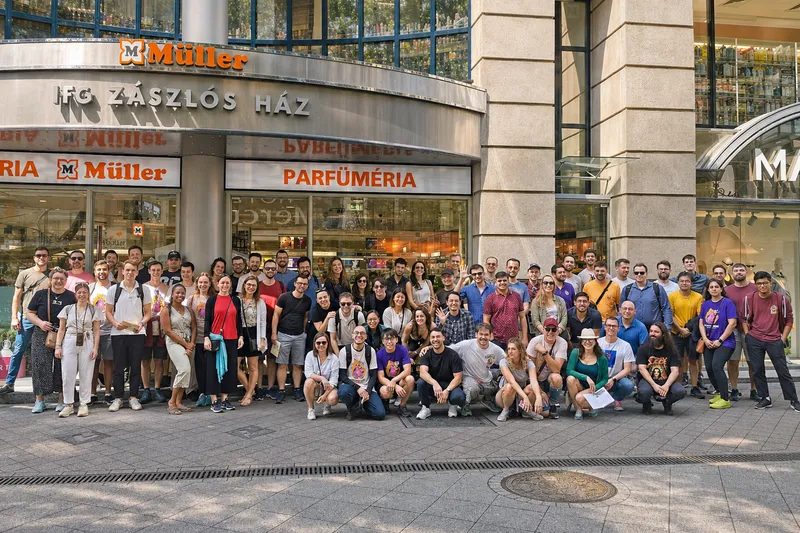
Running team building in Budapest for 15 people is easy. For 120 conference delegates arriving from a dozen countries, it is a different exercise: you need a format that keeps everyone engaged, logistics that don't fall apart, and a finale where the whole group comes back together. Here is what we have learned from running large-group events in the city.
What changes with a large group
With a large group the main risk is not boredom but fragmentation. People stay with the colleagues they already know, the energy drops while groups wait for each other, and the event ends without a shared moment. A good large-group format solves three problems at once:
- Everyone active at the same time — no waiting in line for your turn
- Mixed teams — small teams of 4–6, ideally put together across departments or offices
- One shared finale — an award ceremony where results are announced for the whole group
Formats that scale (and those that don't)
Activities that run in many parallel teams scale well; activities tied to a room or a station don't.
| Format | Up to 30 | 30–80 | 80–200 | 200+ |
|---|---|---|---|---|
| Outdoor treasure hunt | ✓ Excellent | ✓ Excellent | ✓ More Game Masters | ✓ More Game Masters |
| Pub quiz | ✓ Good | ✓ Works | ⚠ Large venue needed | ⚠ Passive at scale |
| Wine tasting | ✓ Good | ✓ Works | ⚠ Split into rounds | ✗ Hard to manage |
| Escape room | ✓ Good | ⚠ Many venues | ✗ Breaks down | ✗ Not viable |
| Cooking class | ✓ Good | ⚠ Venue limits | ✗ Several venues | ✗ Not viable |
| Danube cruise | ✓ Works | ✓ Works | ✓ Large boats | ⚠ Passive |
An outdoor treasure hunt is the most robust choice for 50–300 people: teams play simultaneously, the city absorbs the group, and the shared scoring brings everyone back together at the end. For large groups we deploy one Game Master per 40–50 participants: everyone starts together from the same meeting point, and the scoring is shared so the ranking is fair.
Logistics in Budapest
Keep the whole event in the centre of Pest and you avoid most transport problems.
- Meeting point: Vörösmarty Square and Erzsébet Square are both a few minutes' walk from Deák Ferenc tér, where metro lines M1, M2 and M3 meet. For very large groups, starting at the conference hotel saves a transfer.
- Getting the group there: if you are coming from a conference venue outside the centre, book coaches with a drop-off point agreed in advance — stopping a coach on the narrow streets of Belváros is not always possible.
- Restaurant for the finale: venues that seat 100+ people in the centre are limited and fill up quickly from April to October. Book them first, then plan the activity around them.
- Team composition: send us the participant list in advance if you want mixed teams; otherwise we form teams on the spot.
- Communication: share a short invitation beforehand so people know what to wear and bring — our participant invitation is ready to forward.
Timing and season
Budapest summers are hot, and large groups move more slowly than small ones. In July and August avoid starting between 12:00 and 15:00; late afternoon is ideal, with dinner straight after. Spring and autumn are the most comfortable seasons. From late November the Christmas market occupies Vörösmarty Square, so we move the meeting point a few streets away.
Allow 30 extra minutes for a large group compared with a small one: briefing 300 people, handing out kits and gathering everyone for the awards simply takes longer.
Sample afternoon for 120 people
| Time | Programme |
|---|---|
| 15:30 | Arrival at the meeting point near Vörösmarty Square; three Game Masters welcome the group |
| 15:45 | Briefing, 24 teams of five, kits handed out; all teams start together from the meeting point |
| 16:00–18:00 | Treasure hunt through Belváros and Lipótváros, along the Danube to Parliament |
| 18:15 | All teams arrive at the restaurant; answers are marked during drinks |
| 18:45 | Award ceremony with the best photos, then dinner |
For a group of 120 a treasure hunt costs €22 per person (excl. VAT), with Game Masters, materials and prizes included. Our planning guide covers the full timeline, from the first quote to the event day.